


Leadership Isn’t a Position. It’s a Psychological Responsibility.
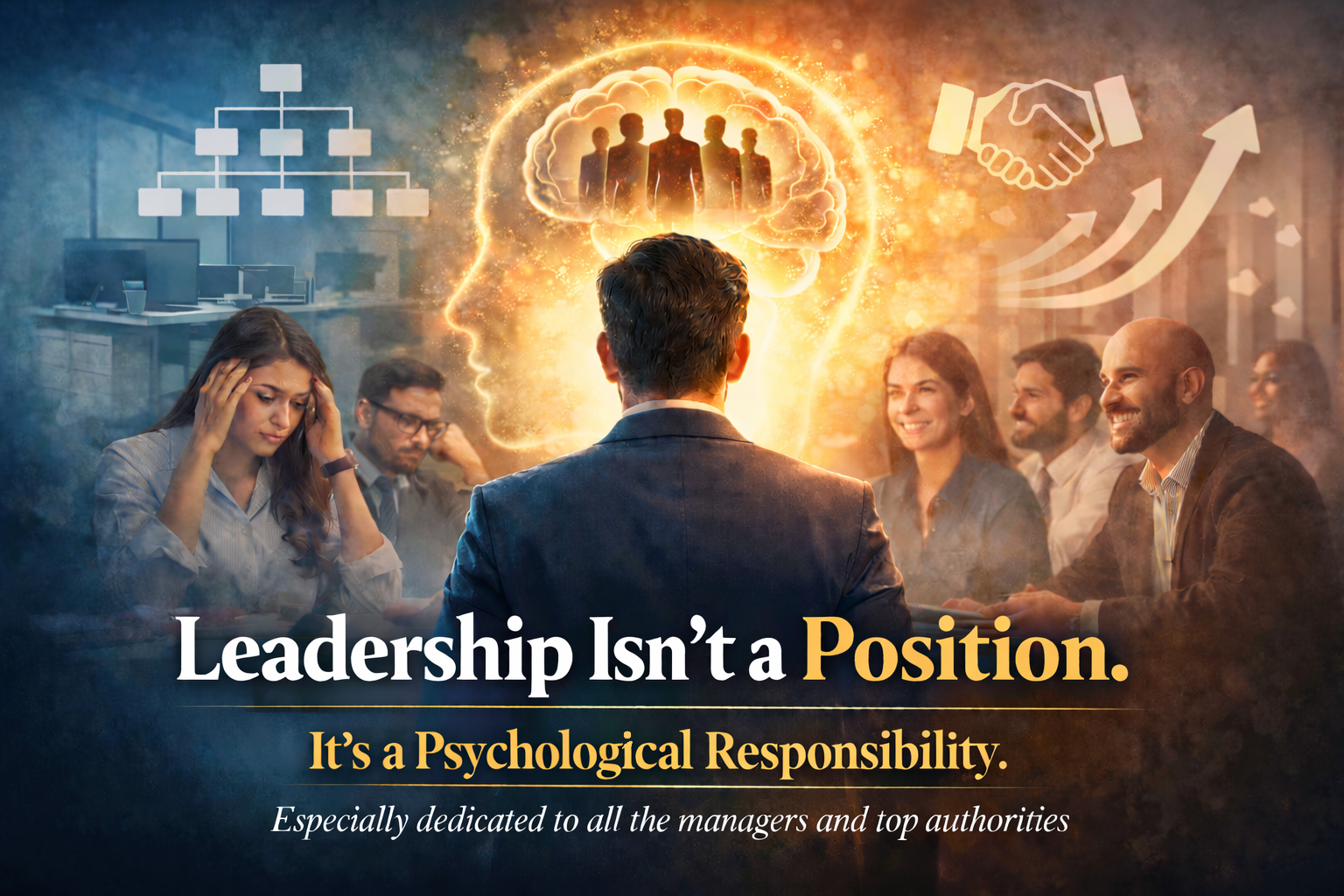
We’ve been taught a very convenient definition of leadership:
“You’re a leader when you have authority.” Designation, team size, reporting lines, power.
But real life doesn’t work like that. Because people don’t experience your “authority.” They experience your presence.
They experience:
-
How safe it feels to speak in front of you
-
How you respond when things go wrong
-
Whether you listen to understand or listen to reply
-
Whether your mood controls the room
So here’s the uncomfortable truth: Leadership is not a title. It’s a psychological responsibility. And if you’re leading humans (not machines), then psychology is not optional.
Why this topic matters?
Because the world is disengaged
Let’s start with the real cost of poor leadership environments. Gallup’s global workplace research shows that only 21% of employees worldwide were engaged in 2024, with a significant drop from the previous year. Low engagement also carries a measurable economic cost — Gallup estimates $438 billion in lost productivity globally in 2024.
Now here’s the important part: Gallup also highlights that manager engagement fell (manager engagement down to 27% globally), and they emphasize a powerful finding repeated across their work: managers influence team engagement massively.
So if a workplace is disengaged, it’s not always because people are “lazy” or “unmotivated.” Very often, it’s because the psychological environment is weak.
The “psychological responsibility” leaders carry
When someone becomes a leader, they don’t just get tasks, they become a psychological signal for the team. Your team unconsciously watches you for cues:
-
Is it safe to ask questions here?
-
Do mistakes get punished or handled?
-
Will I be embarrassed if I disagree?
-
Is feedback fair or emotional?
-
Does my work matter to anyone?
This is why two teams in the same company can feel like two different worlds. Same policies. Same salary. Same office. But one team thrives and another silently collapses. The difference is usually the leader’s emotional and behavioral patterns.
Psychological Safety: the foundation of high-performing teams
If you want one concept that explains modern leadership better than any other, it’s this: Psychological safety = people feel safe to take interpersonal risks.
That means they can:
-
Ask “basic” questions
-
Admit mistakes early
-
Challenge ideas respectfully
-
Share uncomfortable truths
-
Speak up before a problem becomes a disaster
Google’s research initiative on team effectiveness (often associated with “Project Aristotle”) popularized psychological safety as a key ingredient in effective teams. Google’s own guidance on team effectiveness describes psychological safety as the perception of the consequences of taking an interpersonal risk.
Now connect this to leadership: If a leader creates fear, people don’t stop having problems, they just stop reporting them. That’s how small issues become big failures.
Emotional Intelligence is not “soft”. It’s operational.
Many leaders still think emotional intelligence is a “nice-to-have.” But emotional intelligence is simply this: Can you manage yourself well enough to lead others well?
Harvard Business School Online explains emotional intelligence in leadership as essential for coaching, feedback, collaboration, and managing pressure. And Harvard Business Review has long argued that leadership is deeply emotional. Leaders influence outcomes through emotional dynamics, including how their mood affects the group.
In simple terms: A leader’s emotional pattern becomes a team’s emotional culture.
India lens: Wellbeing and leadership environments
Now let’s bring it home. In India, workplace wellbeing indicators are often worrying. A Gallup-based report highlighted that only 14% of Indian workers were “thriving” in overall wellbeing (with most “struggling” or “suffering”), compared with higher global averages reported in the same coverage.
And Deloitte’s India-focused work on mental health and wellbeing in corporate India is based on a large employee survey (thousands of responses), underscoring that employee wellbeing challenges are not “rare cases,” but widespread, structural concerns.
So when we say “leadership is a psychological responsibility,” in India it becomes even more important because:
-
Hierarchical culture can discourage speaking up
-
Feedback often feels personal, not developmental
-
Managers are frequently promoted for performance, not people skills
-
Many teams operate with unspoken fear and comparison
The most underestimated truth: Your manager shapes your engagement
Gallup repeatedly emphasizes a hard-hitting point: Managers account for a huge share of engagement variance in teams. Their estimate is 70% of the variance in team engagement. Read that again. Not salary. Not office food. Not team outings. But, The manager.
So when we talk about leadership, we’re not talking about motivation posters. We’re talking about measurable, business-impacting psychology.
What leaders must do in detail (the full model)
Below are the core “aspects” leadership must cover today, not just theoretically, but behaviorally.
1) Create clarity (uncertainty destroys performance)
A psychologically healthy team knows:
-
What success looks like
-
What matters this week
-
Who owns what
-
What the priorities are (and what they’re not)
Confusion is not neutral. Confusion creates anxiety, rework, conflict, and politics. Leadership responsibility: translate complexity into clarity.
2) Build safety without lowering standards
Psychological safety does NOT mean “anything goes.” It means:
-
We can speak honestly here.
-
We can challenge ideas without attacking people.
-
We can admit mistakes early and fix them.
Safety plus standards is where high performance lives.
3) Regulate yourself (your mood is contagious)
If your emotions become unpredictable:
-
People will start walking on eggshells
-
Communication becomes political
-
Truth becomes filtered
-
Innovation dies quietly
HBR’s work on “primal leadership” discusses how a leader’s mood can influence group performance and dynamics. Leadership responsibility: don’t make your team pay the price of your unprocessed emotions.
4) Turn feedback into development (not humiliation)
Bad feedback sounds like: “You always do this,” “This is common sense,” “How can you not know this?”
Good feedback sounds like: “Here’s what worked,” “Here’s what needs improvement,” “Here’s how we’ll support you,” “Let’s agree on the next step.”
Emotionally intelligent feedback builds competence and trust.
5) Build belonging (especially in hybrid/distributed work)
Hybrid work has one big risk: People can feel like “resources,” not humans. When belonging is missing:
-
People stop contributing beyond the minimum
-
Collaboration becomes transactional
-
Loyalty reduces
-
Detachment increases
6) Train managers like it’s a business priority (because it is)
One reason leadership environments break is simple: Many managers were never trained to manage humans. When managers aren’t developed, they copy what they experienced: micromanagement, emotional outbursts, avoidance.
What Leadership Nation stands for
At Leadership Nation, we believe leadership is an inside-out game. Not because it sounds spiritual. But because it’s practical. If a leader learns to:
-
Regulate emotions
-
Communicate clearly
-
Create psychological safety
-
Handle mistakes with maturity
-
Develop people instead of controlling them
Then performance becomes sustainable. Because people don’t do their best work in fear, they do their best work in clarity + safety + trust.
The reality-check question every leader should ask
Before your next meeting, ask yourself: “What psychological experience am I creating for my people?”
Are you creating:
-
Safety or fear?
-
Clarity or confusion?
-
Growth or shame?
-
Trust or politics?
Because leadership is not what you announce, leadership is what your team feels after interacting with you.
Practical metrics (how to measure this, not just talk about it)
If you want this to be actionable, here are measurable signals leaders and HR can track:
-
Psychological safety pulse: Simple quarterly survey items: “I can speak up without negative consequences.”
-
Manager effectiveness pulse: Clarity, fairness, support, coaching.
-
1:1 consistency: Percentage of team members receiving regular 1:1s.
-
Internal mobility & growth: Teams that develop people retain people.
-
Engagement by team, not company, because manager effect is real.
Closing
Leadership is not a chair you sit on. It’s a psychological responsibility you carry. Because in the end, people may forget your KPIs, but they will never forget how safe they felt around you.
— Leadership Nation